Showing posts with label Islamic Months. Show all posts

Thursday, July 9, 2015

Golden Moments are here!

RAMADHAAN’S GOLDEN MOMENTS 

alhamdulillaah, the Last Ten Days of Ramadhaan, especially the Laylatul Qadr nights have come to embrace us and shower immense blessings upon us, Inshaa’Allah.

‘Aa’ishah (radiyallaahu anha) said:

“When the last ten days (of Ramadan) would come, the Prophet (sal-lal-laahu `alaihi wa sallam) would spend his nights in worship, wake his family (at night), exert himself and tighten his Izaar (waist-cloth).”

This hadeeth is proof that the Last Ten Days of Ramadhaan are very special in comparison to any other set of days in Islamic calendar.

You must be aware that in Islamic calendar night comes first and then the day.

And according to authentic hadeeths, Laylatul Qadr falls in one of the odd nights of the last 10 days of Ramadhaan. 

So please be reminded that:

In places where Ramadhaan commenced on 18th June, the odd nights will fall on:

7th July (21st Night), 9th July (23rd Night), 11th July (25th Night), 13th July (27th Night) and 15th July (29th Night)……Inshaaallah.

and in places where Ramadhaan commenced on 19th June, the odd nights will fall on:

8th July (21st Night), 10th July (23rd Night), 12th July (25th Night), 14th July (27th Night) and 16th July (29th Night)……Inshaaallah.

It is wiser, however, to spend all the nights, irrespective of odd or even, in the worship and glorification of Allah Subhanahu Wa Ta’aala.

And now, a few useful links before you scroll down to read about the golden moments, Inshaa’Allah.

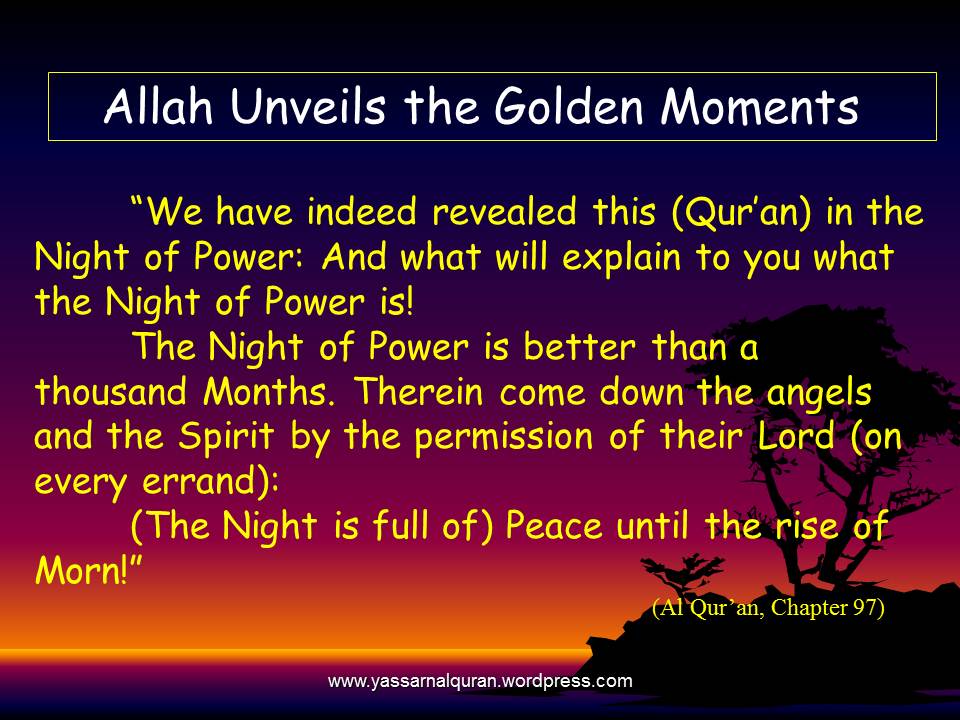
Now, dear brothers and sisters, I would like to present a few facts on this Blessed Night, alhamdulillah.

If you want, you can download this as presentation, Inshaa’Allah:

 JAZAKALLAAHU KHAYRA for reading this post

Visit my Qur'an Blog, Inshaaallah/

dua at gathering

Thursday, July 8, 2010

The month of Rajab

By Mufti Taqi Usmani

Rajab is the seventh month in the Islamic lunar calendar. This month was regarded as one of the sacred months (Al-Ashhur-al-hurum) in which battles were prohibited in the days of the Holy Prophet Sall-Allahu alayhi wa sallam. It is also a prelude to the month of Ramadan, because Ramadan follows it after the intervening month of Sha'ban. Therefore, when the Holy Prophet Sall-Allahu alayhi wa sallam sighted the moon of Rajab, he used to pray to Allah in the following words:

"O Allah, make the months of Rajab and Sha'ban blessed for us, and let us reach the month of Ramadan (i.e. prolong our life up to Ramadan, so that we may benefit from its merits and blessings)."

Yet no specific way of worship has been prescribed by the Shari'ah in this month. However, some people have invented some special rituals or practices in this month, which are not supported by reliable resources of the Shari'ah or are based on some unauthentic traditions. 

We would like to explain here the correct position about them.

1. Celebration of Lailatul Mi'raj
It is generally believed that the great event of Mi'raj (ascension of the Holy Prophet Sall-Allahu alayhi wa sallam to the heavens) took place in the night of 27th of Rajab. Therefore, some people celebrate the night as "Lailatul- Mi'raj" (the night of ascension to heavens).
Indeed, the event of mi'raj was one of the most remarkable episodes in the life of our beloved Holy Prophet Sall-Allahu alayhi wa sallam. He was called by Almighty Allah. He traveled from Makkah to Baitul-Maqdis and from there he ascended the heavens through the miraculous power of Allah. He was honored with a direct contact with his Creator at a place where even the angels had no access. This was the unique honor conferred by Allah to the Holy Prophet Sall-Allahu alayhi wa sallam alone. It was the climax of the spiritual progress which is not attained by anybody except him. No doubt the night in which he was blessed with this unparalleled honor was one of the greatest nights in the history of this world.

But, Islam has its own principles with regard to the historic and religious events. Its approach about observing festivals and celebrating days and nights is totally different from the approach of other religions. The Holy Qur'an and the Sunnah of the Holy Prophet Sall-Allahu alayhi wa sallam did not prescribe any festival or any celebration to commemorate an event from the past, however remarkable it might have been. Instead, Islam has prescribed two annual celebrations only. One is Eid-ul-Fitr and the other is Eid ul-Adha. Both of these festivals have been fixed at a date on which the Muslims accomplish a great 'ibadah (worship) every year. Eid-ul-Fitr has been prescribed after the fasts of Ramadan, while Eid-ul-Adha has been fixed when the Muslims perform the Hajj annually. None of these two eids is designed to commemorate a particular event of the past which has happened in these dates. This approach is indicative of the fact that the real occasion for a happy celebration is the day in which the celebrators themselves have accomplished remarkable work through their own active effort. As for the accomplishments of our ancestors, their commemoration should not be restricted to a particular day or night. Instead, their accomplishments must be remembered every day in the practical life by observing their teachings and following the great examples they have set for us.

Keeping this principle in view, the following points should be remembered with regard to the "Lailatul-mi'raj":

(1) We cannot say with absolute certainty in which night the great event of mi'raj took place. Although some traditions relate this event to 27th night of the month of Rajab, yet there are other traditions that suggest other dates. Al-Zurqani, the famous biographer of the Holy Prophet Sall-Allahu alayhi wa sallam has referred to five different views in this respect: Rabi-ul-Awwal, Rabi-u-Thani, Rajab, Ramadan and Shawwal. Later, while discussing different traditions, he has added a sixth opinion, that the mi'raj took place in the month of Zulhijjah.

Allama Abdulhaq Muhaddith Dehlawi, the well-known scholar of the Indian subcontinent, has written a detailed book on the merits of Islamic months. While discussing the 'Lailatul-mi'raj' has mentioned that most of the scholars are of the view that the event of mi'raj took place in the month of Ramadan or in Rabi-ul-awwal.

(2) It is also not known in which year the event of Mi'raj took place. The books of history suggest a wide range between the fifth-year and the twelfth year after the Holy Prophet Sall-Allahu alayhi wa sallam was entrusted with prophethood.

Now, if it is assumed that the event of Mi'raj took place in the fifth year of his prophethood, it will mean that the Holy ProphetSall-Allahu alayhi wa sallam remained in this world for eighteen years after this event. Even if it is presumed that the mi'raj took place in the twelfth year of his prophethood, his remaining life-time after this event would be eleven years. Throughout this long period, which may range between eleven years and eighteen years, the Holy Prophet Sall-Allahu alayhi wa sallam never celebrated the event of mi'raj, nor did he give any instruction about it. No one can prove that the Holy Prophet Sall-Allahu alayhi wa sallam ever performed some specific modes of worship in a night calling it the 'Lailatul-mi'raj' or advised his followers to commemorate the event in a particular manner.

(3) After the demise of the Holy Prophet Sall-Allahu alayhi wa sallam also, no one of his companions is reported to celebrate this night as a night of special acts of worship. They were the true devotees of the Holy Prophet Sall-Allahu alayhi wa sallam and had devoted their lives to preserve every minute detail of the sunnah of the Holy Prophet Sall-Allahu alayhi wa sallam and other Islamic teachings. Still, they did not celebrate the event of mi'raj in a particular night in a particular way.

All these points go a long way to prove that the celebration of the 27th night of Rajab, being the lailatul-mi'raj has no basis in the Sunnah of the Holy Prophet Sall-Allahu alayhi wa sallam or in the practice of his noble companions. Had it been a commendable practice to celebrate this night, the exact date of this event would have been preserved accurately by the Ummah and the Holy ProphetSall-Allahu alayhi wa sallam and his blessed companions would have given specific directions for it.

Therefore, it is not a Sunnah to celebrate the Lailatul-mi'raj'. We cannot declare any practice as a sunnah unless it is established through authentic sources that the Holy Prophet Sall-Allahu alayhi wa sallam or is noble Companions have recognized it as such, otherwise it may become a bid'ah about which the Holy Prophet Sall-Allahu alayhi wa sallam has observed in the following words: "Whoever invents something in our religion which is not a part of it, it is to be rejected."

Being mindful of this serious warning, we should appreciate that the 27th night of the month of Rajab is not like 'Lailatul-qadr' or 'Lailatul-bara'ah' (Note: I must mention here that even celebrating the lailatul bara'ah has been rejected by most of the scholars - Blog Administrator) for which special merits have been mentioned expressly either y the Holy Qur'an or by the Holy Prophet Sall-Allahu alayhi wa sallam.

However, all the recognized modes of 'ibadah (worship) like Salat, recitation of the Holy Qur'an, dhikr, etc. are commendable any time, especially in the late hours of night, and obviously the 27th night of Rajab is not an exception. Therefore, if someone performs any recognized 'ibadah in this night from this point of view nothing can stop him from doing so, and he will be entitled to the thawab (reward allocated for that recognized 'ibadah insha-Allah.) But it is not permissible to believe that performing 'ibadah in this night is more meritorious or carries more thawab like 'Lailatul-qadr' or 'Lailatul-bara'ah', because this belief is not based on any authentic verse or on a sunnah of the Holy Prophet Sall-Allahu alayhi wa sallam. Similarly, it is not a correct practice to celebrate this night collectively and to invite people to special ritual congregations.

(4) Some people suggest some special modes of worship to be performed in this night. Since no special mode of worship is prescribed by the Shari'ah in this night, these suggestions are devoid of any authority and should not be acted upon.

It is believed by some that the Muslims should keep fast on 27th of Rajab. Although there are some traditions attributing special merits to the fast of this day yet the scholars of hadith have held these traditions as very weak and unauthentic reports which cannot be sufficient to establish a rule of Shari'ah. On the contrary, there is an authentic report that Sayyidna 'Umar, Radi-Allahu anhu, used to forbid people from fasting on this day, rather to compel them to eat if they had started fasting.

It should be borne in mind here that a "nafl" fast can be observed any day (except the six prohibited days of the year); therefore, fasting on 27th of Rajab is not prohibited in itself. What is prohibited is the belief that fasting on this day is more meritorious than fasting in other normal days. One should not fast in this day with this belief. But if someone fasts therein, believing it to be a normal nafl fast, there is no bar against it.

Sacrifice (qurbani) in the month of Rajab
In the days of ignorance (jahiliyyah) the Arabs used to offer the sacrifice of a goat in the month of Rajab. This sacrifice used to be called "Atirah' or 'Rajabiyyah'. This sacrifice was offered in the name of different so-called gods and their icons. In the beginning of Islam, this custom was retained, but the Muslims modified it by offering the sacrifice of 'Atirah in the name of Allah instead of the false gods. But finally, this custom was abandoned and the Holy Prophet Sall-Allahu alayhi wa sallam prohibited the offering of 'Atirah. In a tradition of Sayyidna Abu Hurairah, Radi-Allahu anhu, reported by both al-Bukhari and Muslim, the Holy Prophet Sall-Allahu alayhi wa sallam has said: "Fara' is nothing and 'Atirah is nothing."

Abu Hurairah, Radi-Allahu anhu, has explained in the same tradition that 'Fara" was the first child of a she-camel. Whenever a she-camel delivered its first child, the Arabs used to sacrifice it in the name of their so-called gods, while the 'Atirah' was a goat used to be sacrificed in the month of Rajab. Since the Holy Prophet Sall-Allahu alayhi wa sallam stopped both these customs, 'Atirah is no longer a recognized practice.

'Umrah in the month of Rajab
Ibn 'Abidin, the well-known scholar of the Islamic jurisprudence, has mentioned that the people of Makkah (in his days) used to perform 'umrah in the month of Rajab. Perhaps they believed that performing 'umrah in this month is more meritorious than in other months. Then Ibn Abidin himself has rejected the authenticity of this practice, because no tradition of the Holy Prophet Sall-Allahu alayhi wa sallam is found to this effect. Conversely Sayyidah 'Aishah, Radi-Allahu anha, has expressly negated the presumption by saying that the Holy Prophet Sall-Allahu alayhi wa sallam never performed an 'umrah in the month of Rajab (Sahih Muslim 1:409)

However, Ibn 'Aibidin has quoted a narration that 'Abdullah ibn Zubair, Radi-Allahu anhu, completed the renovation of Ka'bah shortly before 27th of Rajab, and as a sign of gratefulness he performed 'umrah and slaughtered some animals. But this report cannot form the basis of a recognized annual practice, firstly because the report is not very authentic, and secondly because it does not mention that Abdullah ibn Zubair, Radi-Allahu anhu, had adopted it as a continuing practice. At the most, he performed 'umrah once as a sign of gratefulness on the completion of Ka'bah. It does not mean that he performed it as a characteristic of the month of Rajab. Therefore, performing 'Umrah in this month is like performing it in any other month and no special merit can be attached to it merely because it has been performed in the month of Rajab.

The Salat of "Ragha'ib"
Another special mode of worship attributed by some people to this month is the Salat of Raghai'b. According to the custom of such people, this Salat is performed in the night of first Friday of the month of Eajab. The Salat of Raghaib is said to consist of twelve rak'ats to be performed in pairs with six salams, and in each rak'at the surah al-qadr is recited three times followed by the Surah-al-ikhlas. This type of Salat is also not based on any sound source of Shari'ah. Therefore, almost all the jurists and scholars of Shari'ah have held that the Salat of Raghaib is a baseless practice and it is not permissible to treat it as a recognized practice of this month. It is true that there is a tradition, narrated by Razin, the author of a book of hadith, which attributes the origin of this practice to the Holy ProphetSall-Allahu alayhi wa sallam but almost all the scholars of the science of hadith have held it to be absolutely unauthentic. Therefore, no importance can be attached to it.

Distribution of Breads:
Another baseless practice in the month of Rajab is that the people bake special types of breads and, after reciting some verses and prayers on them, distribute them among their friends and neighbors. This custom has two different shapes.
1). In some communities, this custom is celebrated on 17th of Rajab on the assumption that Sayyidna Ali, Radi-Allahu anhu, was born on 11th of Rajab and the 17th of Rajab is the day on which his 'Aqiqa (Shaving of his head) was performed. In order to celebrate this happy event, the breads of some special type are prepared and after reciting Surah Al-Mulk on them, they are distributed among the relatives and friends. These breads are generally called "breads of Tabarak" because Surah Al-Mulk is usually recited on them.

This practice is baseless because it is never proved that Sayyidna Ali, Radi-Allahu anhu, was born on 11th of Rajab or that his Aqiqa was performed on 17th of this month and, as explained earlier, even if these events are proved to have happened in those days, their commemoration through these specific rituals is not warranted by the Shari'ah.

2). A more common practice of this type is observed on 22nd of Rajab whereby some breads and meals of a special type are prepared and distributed among the people. Since these special meals are usually placed in some bowls made of clay, the custom is usually known as "Koonda", an Urdu equivalent of such bowls. It is usually believed that the custom is designed to make 'isal-al-thawab to the soul of Sayyidna Jafar Al-Sadiq who himself has directed his followers to observe this custom and has promised them that whoever observes it, his desires will be fulfilled.

All these assumptions also have no basis at all, neither historically, nor according to the principles of Shari'ah. In fact, the date of 22nd of Rajab has no concern whatsoever with Sayyidna Jafar al-Sadiq, Rahimah-u-Allah. According to the historians, he was born on 8th of Ramadan 80 A.H. and died in Shawwal 148 A.H. No specific event of the life of Sayyidna Jafar al-Sadiq is proved to have happened on this date. The people believing in the custom refer to a coined story mentioned in an unauthentic book named "Dastaan-e-Ajeeb".
Briefly stated, the gist of the story is that a poor woodcutter lived in Madinah in the days of Jafar Al-Sadiq. He went abroad to earn his livelihood. His wife was employed in the house of the Prime Minister. Once she was cleaning the courtyard of the Prime Minister when Sayyidna Jafar al-Sadiq passed by her. It was 22nd of Rajab. He advised her to bake some breads of a special type and make 'isal-al-sawab to him. According to this story, he promised her that if her desire is not fulfilled after this practice, she can catch hold of him at the doom's day. On hearing this, the woman made a vow that if her husband will come back with a considerable wealth, she will observe the custom of "Koonda". On the same day her husband, who was in another country, found a valuable treasure in the earth and came back with it to Madinah where he established himself as a rich man and started living in a magnificent castle. 

When his wife told the story to the wife of the Prime Minister, she disbelieved her and because of this disbelief, she and her husband, the Prime Minister, were punished by Allah. He was removed by the king from the prime minister-ship and was imprisoned in a jail and was ordered to be hanged. While being in the prison, the wife of the Prime Minister remembered that she had disbelieved the story of Jafar al-Sadiq told to her by her maidservant and their misery might be the punishment of their disbelief. On this point, she and her husband repented before Allah and made a vow to observe the custom of "Koonda", if they are released from the jail. After they made such a vow, the whole scenario of the events changed suddenly. The king released the Prime Minister from the jail and reinstated him on his former position.

As it can be seen by any reasonable person, this story is totally forged on the face of it. The person who has coined this story did not even know that Madinah had never a king nor a Prime Minister. All the Muslim rulers were named as caliphs and had no Prime Minister at all. In the days of Umayyads, their capital was Damascus and in the days of Abbasids, their permanent seat was in Baghdad.

It is ironical that the story of such a woodcutter is not even known to anybody in Madinah, nor in any city of the Arab countries. No Arabic book has ever referred to it. It has no mention except in an Urdu book 'Dastaan-e-Ajeeb', the author of which is unknown. One can easily see that a custom based on such a fallacious and mythical story can never be an Islamic custom. Islam has always been far away from such superstitions.

Therefore, this baseless custom should completely be avoided by the true Muslims. Some historians have opined that in fact, this custom has been coined by some Shi'ites because the date of 22nd of Rajab is the date of the demise of Sayyidna Mu'awiyah whom they take as their biggest enemy. They took that date as a happy occasion and made the Sunni Muslims also to celebrate it on the pretext of the above mentioned story.

Be that as it may, it is evident that such customs have crept into the Muslim society by their long association with Hindus who commemorate different historical events of their religion in the like manner. The Muslims must be careful about these customs, because they are not only an invention of ignorance but also the imitation of non-Muslims in their religious rituals. No doubt the "'isal-al-thawab' to the soul of a deceased Muslim, and particularly to a pious person is not only permissible but also a commendable practice but the Shari'ah has not prescribed a particular date, nor a particular mode to do so. If someone wants to make "'isal-al-thawab" to Sayyidna 'Ali, Radi-Allahu anhu, or to Ja'far al-Sadiq, he can do it any day and by performing any act of worship, like Salat, fast, Sadaqah, dhikr etc. There is no reason why it should be restricted to a special type of meal or bread distributed on a particular date. What makes this practice worse is the fact that the people accustomed to this practice deem it as necessary as a fard (obligation); rather they treat it as more necessary than fard because they do not care to perform the obligatory Salat or to fulfill the rights of men obligated on them, but they are very strict and punctual to perform these activities. Moreover, if a person does not observe this practice, they reproach him and call him with bad names. Such behavior makes this custom a bid'ah which is condemned by the Holy Prophet Sall-Allahu alayhi wa sallam as a misguidance. 

Therefore, the Muslims must abandon all such practices and should not cling to it only because it has been the practice of their society for many years. A Muslim is supposed to follow the dictates of Shari'ah and not the practice of the society, if it violates any of its principles.

Conclusion
The upshot of the above discussion is that the Shari'ah has not prescribed any specific way to observe the month of Rajab or to perform a specific mode of worship or a ritual in any one of its dates. However, being a prologue to the month of Ramadan, it should be availed of for preparing oneself for Ramadan and one should pray Allah to make him reach the blessed month and to benefit from its unique merits.

Sunday, February 14, 2010

The Month of Rabi-ul-Awwal


Rabi-ul-Awwal is the most significant month in the Islamic history, because humanity has been blessed in this month by the birth of the Holy Prophet Muhammad (Pbuh). Before the birth of the Holy Prophet, not only the Arabian peninsula, but also the so-called civilised nations of Rome and Persia were drowned in the darkness of ignorance, superstitions, oppression and unrest. The Holy Prophet came with the eternal truth of Tawhid (Oneness of Allah), the only faith which provides a firm basis for the real concepts of knowledge, equity and peace. It was this faith which delivered humanity from ignorance and superstitions and spread the light of true knowledge all over the world.

Thus the birth of the Holy Prophet was the most significant and the most remarkable event in human history.Had there been room in Islamic teachings for the celebration of birthdays or anniversaries, the birthday of the Holy Prophet, would have undoubtedly deserved it more than the birthday of any other person. But that is against the nature of Islamic teachings. 

On the other hand, Islam has not prescribed any festival for the birthday of any person, however great or significant he may be. The prophets of Allah are the persons of the highest status amongst all human beings. But the Holy Prophet, or his noble companions never observed the birthday or anniversary of any of them. Even the birthday of the Holy Prophet, which was the most happy day for the whole mankind was never celebrated by the Holy Prophet, himself, nor by his blessed Companions. 

The Companions of the Holy Prophet, remained alive after him for about a century, but despite their unparalleled and profound love towards the Holy Prophet, they never celebrated the birthday or the death anniversary of the Holy Prophet. Instead, they devoted their lives for promoting the cause of Islam, for bringing his teachings into practice, for conveying his message to the four corners of the world and for establishing the Islamic order in every place. 

The Holy Qur’an has clearly pronounced on the occasion of the last Hajj of the Holy Prophet (Peace be upon him): “Today, I have completed the teachings of your religion.” [Al-Maida 5:3] 

It means that all the teachings of Islam were communicated to the Muslims through the Holy Qur’an and the Sunnah of the Holy Prophet. No one is allowed after it to add any thing to them as a part of religion. What was not a part of religion during the lifetime of the Holy Prophet, can never become part of it. Such additions are termed by the Holy Prophet, as Bid’ah or innovation. 

Thus, the observance of the 12th of Rabi’ul-Awwal as a religious feast is not warranted by any verse of the Holy Qur’an or by any teaching of the Holy Prophet. 

The observance of the 12th of this month as the birthday of the Holy Prophet, (Pbuh) is not only an innovation having no basis in the Islamic teachings, but the accuracy of this date as the real birthday of the Holy Prophet, is also very much doubted. There are different dates suggested in different traditions, and the majority of the authentic scholars are inclined to hold that the Holy Prophet, (Pbuh), was born on the 9th of Rabi’ul-Awwal. This difference of opinion is another evidence to prove that the observance of the birthday is not a part of the religion, otherwise its exact date would have been preserved with accuracy. 

The life of the Holy Prophet is, no doubt, the most important source of guidance for all the Muslims, and every Muslim is under an obligation to learn and study the events of his life, and to follow the practical example set by him in every sphere of life. The narration of his pious biography (the Seerah) in itself is a pious act, which invites the divine blessings, but the Holy Qur’an and the Sunnah have not prescribed a particular time or method for it. This pious act should be performed in all the months and at all the times. 

The month of Rabi’ul-Awwal has not been designated by the Shariah as a special season for holding such congregations to commemorate the birth or life of the Holy Prophet, (Pbuh). It is thus an innovation (Bid’ah) to restrict the Seerah meetings to the month of Rabi’ul Awwal only, or to believe that the meetings held in this month are worthy of more reward than the meetings held on any other date during the year. In fact, the Companions of the Holy Prophet, used to commemorate the life of the Holy Prophet, throughout the year, not only by studying and conveying his message to others, but also by following his way of life and acting upon his teachings in each and every branch of their activities, and this is exactly what a Muslim is required and supposed to do. 

By this we do not mean that the Seerah meetings should not be held in the month of Rabi-ul-Awwal. The point is only that they should not be restricted to it, nor should it be believed that the Shariah has laid any kind of emphasis on holding such meetings in this particular month. 

All other activities, often practiced on the twelfth of Rabi-ul-Awwal, like holding processions, constructing the mock tombs of the Holy Prophet, and illumination of the buildings and the roads are not warranted by any rule of the Shariah. Rather they are based on conscious or unconscious imitation of certain other religions. No example of such activities can be traced out from the earlier Islamic history. 

What is really important with regard to the Holy Prophet, is first, to follow his teachings, and second to make his pious Seerah available to every Muslim, to preserve it in the hearts of the Muslims from the very childhood, to educate the family members to run their lives according to it and to hold it as the most glorious example of the human conduct the universe has ever witnessed — and all this with utmost love and reverence, not manifested by some formal activities only, but also through actual behavior of following the Sunnah. This cannot be done by merely holding processions and illuminating the walls. This requires constant and consistent efforts and a meaningful program of education and training. 

Courtesy: http://www.islamicvoice.com/may.2003/awwal.htm


Friday, January 22, 2010

THE MONTH OF SAFAR: FACTS & FICTION

The Month of Safar

Praise be to Allaah, and blessings and peace be upon the Messenger of Allaah.

The month of Safar is one of the twelve Hijri months, and it is the month which comes after Muharram.

Some of the (scholars) said that it is so named because of the emptying (isfaar) of Makkah (i.e. its people would all leave) when they travelled during this month.

It was also said that this month is named Safar because they used to raid other tribes at this time, and they would leave those whom they encountered bereft of their possessions (sifran min al-mataa') – i.e., they would take all their belongings away and they would leave them with nothing. (See Lisaan al-'Arab by Ibn al-Mandhoor, part 4, p. 462-463)


Our discussion of this month will cover the following points:

1. What has been narrated concerning it from the Arabs of the Jaahiliyyah.

2. What has been narrated in Islam that contradicts the views of people of the Jaahiliyyah concerning this month.

3. False ahaadeeth that have been narrated concerning Safar.

4. Innovations and corrupt beliefs concerning this month that exist among people who claim to be Muslims.

5. What happened in this month of military campaigns and important events in the life of the Prophet (peace and blessings of Allaah be upon him).

1. What has been narrated concerning it from the Arabs of the Jaahiliyyah.

The Arabs were guilty of two serious wrongdoings concerning the month of Safar.

Firstly, they played about with it, bringing it forward or postponing it, and

Secondly, they had superstitions concerning it.

(i) It is known that Allaah created the year and the number of its months is twelve, four of which Allaah has made sacred, in which it was forbidden to fight, out of respect for these months. These months are: Dhu'l-Qi'dah, Dhu'l-Hijjah, Muharram and Rajab.

This is confirmed in the Book of Allaah, where Allaah says : "Verily, the number of months with Allaah is twelve months (in a year), so was it ordained by Allaah on the Day when He created the heavens and the earth; of them four are Sacred (i.e. the 1st, the 7th, the 11th and the 12th months of the Islamic calendar). That is the right religion, so wrong not yourselves therein…" [al-Tawbah 9:36]

The Mushrikeen were aware of that, but they used to postpone it or bring it forward according to their whims and desires, such as putting Safar in place of Muharram!

They used to believe that 'Umrah during the months of Hajj was one of the most evil of actions. There follow some of the comments of the scholars on that.

(a) It was narrated that Ibn 'Abbaas (may Allaah be pleased with them both) said: "They used to think that 'Umrah during the months of Hajj was one of the most evil of actions on earth. They would make Muharram Safar, and they used to say, 'When the wounds of the camel's back heal up (after they return from Hajj) and the footprints of the camels vanish and the month of Safar passes away then (at that time) 'Umra is permissible for the one who wishes to perform it." (Narrated by al-Bukhaari, 1489; Muslim, 1240)

(b) Ibn al-'Arabi said: "The second issue: how postponing (al-nasiy) was done:

(i) It was narrated from Ibn 'Abbaas that Junaadah ibn 'Awf ibn Umayyah al-Kinaani used to come on this occasion each year, and he would call out that no one could criticize Abu Thamaamah or reject what he said, and that Safar in the first year would not be sacred, then we would make it sacred one year and not the next year. They were with Hawaazin, Ghatafaan and Bani Sulaym.

According to another version, he used to say, "We have brought Muharram forward and postponed Safar." Then the next year he would say, "We will make Safar sacred and delay Muharram." This was the postponement.

(ii) Adding. Qutaadah said: Some of the people of misguidance deliberately added Safar to the sacred months. Their spokesman would stand up on this occasion and say, "Your gods have made Muharram sacred this year," and they would regard it as sacred that year. Then the next year he would stand up and say, "Your gods have made Safar sacred," so they would regard it as sacred that year. And they would say (that there were) two Safars. Ibn Wahb and Ibn al-Qaasim narrated something similar from Maalik, who said: the people of the Jaahiliyyah used to have two Safars, hence the Prophet (peace and blessings of Allaah be upon him) said, "(There is) no Safar."

Ashhab also narrated something similar from him.

(ii) Changing the time of Hajj. Mujaahid said with a different isnaad: " 'The postponing (of a Sacred Month) is indeed an addition to disbelief' [al-Tawbah 9:37] – they would perform Hajj in Dhu'l-Hijjah for two years, then they would perform Hajj in Muharram for two years, then they would perform Hajj in Safar for two years. They would perform Hajj in each month for two years until, when Abu Bakr performed Hajj that was in Dhu'l-Qi'dah, then when the Prophet performed Hajj it was in Dhu'l-Hijjah.

Hence the Prophet (peace and blessings of Allaah be upon him) said in his sermon, according to the saheeh hadeeth:

"Time has completed a cycle and assumed the form of the day Allaah created the heavens and the earth." Narrated by Ibn 'Abbaas and others. This version was narrated by him.

And he said: "The Messenger of Allaah (peace and blessings of Allaah be upon him) said:
'O people, listen to what I say, for I do not know whether I will meet you again after this day in this place. O people, your blood and your wealth are sacred until the Day when you meet your Lord, as sacred as this day of yours in this month of yours in this land of your. You will meet your Lord and He will question you about your deeds. I have conveyed (the message). Whoever has had something entrusted to him, let him fulfil that trust.

All riba is abolished. You shall have your capital sums, deal not unjustly and you shall not be dealt with unjustly. Allaah decreed that there should be no riba. The riba of 'Abbaas ibn 'Abd al-Muttalib is abolished. All claims for blood-vengeance belonging to the jaahiliyyah period have been abolished. The first of those murdered among us whose blood-vengeance I remit is Ibn Rabee'ah ibn al-Haarith ibn 'Abd al-Muttalib, who was suckled among Banu Layth and killed by Hudhayl." He was the first one whose blood-vengeance of the jaahiliyyah was abolished.

"O people, the Shaytaan has despaired of ever being worshipped in your land, but he will be pleased to be obeyed in any matter other than that, in matters that you may think of as insignificant. So beware of him in matters of your religion. The postponing (of a Sacred Month) is indeed an addition to disbelief, by which the disbelievers are led astray… Time has completed a cycle and assumed the form of the day Allaah created the heavens and the earth. The number of months with Allaah is twelve, of which four are sacred, three consecutive months, and Rajab Mudar which comes between Jumaada and Sha'baan…" and he mentioned the rest of the hadeeth. (Ahkaam al-Qur'aan, 2/503-504)

With regard to superstitions concerning the month of Safar.

These were well known among the people of the Jaahiliyyah, and still exist among some of those who claim to be Muslims.

It was narrated that Abu Hurayrah said: the Messenger of Allaah (peace and blessings of Allaah be upon him) said: "(There is) no 'Adwa (no contagious disease is conveyed without Allah's permission), nor is there any bad omen (from birds), nor is there any Haamah, nor is there any (bad omen in the month of) Safar, and one should run away from the leper as one runs away from a lion." (narrated by al-Bukhaari, 5387; Muslim, 2220)

Shaykh Ibn 'Uthaymeen (may Allaah have mercy on him) said:

"The word 'Safar' was interpreted in several ways:

(i) that it refers to the well-known month of Safar, concerning which the Arabs were superstitious.

(ii) That it refers to a stomach disease of camels, which is passed from one camel to another, and that this mentioned in conjunction with the word 'adwa (contagion) in the sense of mentioning something specific in conjunction with something general.

(iii) That 'Safar' means the month of Safar, and that what is referred to here is the postponing of Sacred Months by which those who disbelieved were led astray, when they would delay the sacred months and make Safar sacred one year and not the next.

The most correct of these views is that what is meant is the month of Safar, concerning which there were many superstitions during the Jaahiliyyah.

Times have no effect (on people's lives) and Allaah never decreed that it should have any effect. Like any other month, both good and bad may be decreed during this month.

If a particular action is completed on the twenty-fifth of Safar – for example – some people note the date and say, "It has been finished on the twenty-fifth of this good month of Safar." This is like refuting one innovation with another, because there are no good or bad months. Hence some of the salaf denounced those who, when they hear the hooting of an owl, say, "It is good, in sha Allaah." It cannot be said that this is good or bad, it is simply the sound of a bird, like any other bird.

The four things which the Prophet (peace and blessings of Allaah be upon him) denied (in the hadeeth referred to above) indicate that we must put our trust in Allaah and be sincere and determined; the Muslim should not feel helpless when faced with these things.
If a Muslim does pay any attention to such things, one of the following must apply in his case:

Either he pays attention to them in deciding whether to go ahead or refrain, in which case he is basing his actions on something that is not real.

Or he does not pay attention to them with regard to deciding whether to go ahead or refrain, but he still feels some kind of worry or anxiety. Although this is not as bad as the first case, he should not pay any attention to these things at all, rather he should depend only on Allaah.

The denial of these four things is not a denial of their existence, for they do exist; it is a denial of their having any effect on things, for the One Who affects things is Allaah. If there is a reason that is known to have effects, then this is a real reason, and any reason which is merely imagined is a false reason. So we deny its effect and it has no effect. " (Majmoo' Fataawa al-Shaykh Ibn 'Uthaymeen, 2/113, 115)
___________________________________

2. What has been narrated in Islam that contradicts the views of people of the Jaahiliyyah concerning this month

It was narrated that Abu Hurayrah said: the Messenger of Allaah (peace and blessings of Allaah be upon him) said: "(There is) no 'Adwa (no contagious disease is conveyed without Allah's permission), nor is there any bad omen (from birds), nor is there any Haamah, nor is there any (bad omen in the month of) Safar, and one should run away from the leper as one runs away from a lion." (narrated by al-Bukhaari, 5387; Muslim, 2220)

We have quoted above the hadeeth of Abu Hurayrah narrated in al-Saheehayn, which explains that the belief of the people of Jaahiliyyah concerning Safar was reprehensible, and that is it simply one of the months of Allaah and it has no will of its own, it simply passes, subject to the control of Allaah.
___________________________________

3. False ahaadeeth that have been narrated concerning Safar.

Ibn al-Qayyim said: Section of ahaadeeth which give the dates of future events.

This includes ahaadeeth in which it mentions such and such a date, for example, "In the year such and such, such and such will happen" or "In the month such and such, such and such will happen."

This is like the words of the big liar: "When the moon is eclipsed in Muharram, there will be a rise in prices, fighting, and the ruler will be distracted from public affairs, and when it is eclipsed in Safar, such and such will happen… " and so on, as the liar said concerning all the months.

All the ahaadeeth of this type are false and fabricated. (al-Manaar al-Muneef, p. 64)
___________________________________

4. Innovations and false beliefs concerning this month that exist among people who claim to be Muslims.

(1) The Standing Committee was asked:
Some of the scholars in our country claim that in the Islamic religion there is a naafil (supererogatory) prayer which is prayed on the last Wednesday of the month of Safar, at the time of Duha (mid-morning) prayer, (consisting of) four rak'ahs with one tasleem. In each rak'ah one recites Soorat al-Faatihah, Soorat al-Kawthar seventeen times, Soorat al-Ikhlaas 50 times, al-Mi'wadhatayn (the last two soorahs of the Qur'aan) one time each. This is done in each rak'ah, then one says salaam, and when one says salaam it is prescribed to recite "And Allaah has full power and control over His Affairs, but most of men know not" [Yoosuf 12:21] 360 times, and Jawhar al-Kamaal (the essence of perfection) three times, and to finish by saying,

"Glorified be your Lord, the Lord of honour and power! (He is free) from what they attribute unto Him! And peace be on the Messengers! And all the praises and thanks be to Allaah, Lord of the 'Aalameen (mankind, jinn and all that exists)" [al-Saaffaat 37:180].

And they give charity to the poor, and they say that this aayah is especially for warding off the calamities which come down on the last Wednesday of the month of Safar.

They say that every year, 320,000 calamities come down, and all of that comes down on the last Wednesday of Safar, so that is the most difficult day of the entire year. But whoever prays this prayer in the manner described, Allaah will protect him by His generosity from all the calamities that come down on that day, and they will not come around him, but they will affect those who could not do this prayer, like small children. Is this true?

The scholars of the committee replied:
Praise be to Allaah, and blessings and peace be upon His Messenger and upon his family and his companions.

We do not know of any basis in the Qur'aan or in the Sunnah for the naafil prayer mentioned in the question. We have no proof that any one among the salaf of this ummah or the righteous people of its later generations did this naafil prayer. Rather it is a reprehensible innovation.

It was narrated that the Messenger of Allaah (peace and blessings of Allaah be upon him) said: "Whoever does an action which is not in accordance with this matter of ours [Islam], will have it rejected."

And he said: "Whoever innovates something in this matter of ours that is not part of it, will have it rejected."

Whoever attributes this prayer and the things that are mentioned with it to the Prophet (peace and blessings of Allaah be upon him) or to any of the Sahaabah (may Allaah be pleased with them) is fabricating serious lies, and Allaah will give him the punishment for liars which he deserves. (Fataawa al-Lajnah al-Daa'imah, 2/354)

(2) Shaykh Muhammad ibn 'Abd al-Salaam al-Shuqayri said:

The ignorant have the habit of writing down the verses of salaam such as "Salaam (peace) be upon Nooh (Noah) (from Us) among the 'Aalameen (mankind, jinn and all that exists)!"" [al-Saafaat 37:79] etc. on the last Wednesday of the month of Safar, then they put them in vessels and drink it and seek blessings from it, and they give it as gifts to one another, because they believe that this will take away bad things.

This is a false belief and a blameworthy superstition, a reprehensible innovation which must be denounced by everyone who sees it. (al-Sunan wa'l-Mubtada'aat, p. 111, 112)
___________________________________

5. What happened in this month of military campaigns and important events in the life of the Prophet (peace and blessings of Allaah be upon him).

There are many such events, some of which we will refer to below:

(1) The Prophet (peace and blessings of Allaah be upon him)] went on the military campaign of al-Abwaa', also known as Waddaan. This was the first military campaign in which he took part himself. It happened in Safar, twelve months after the Hijrah. The banner, which was white, was carried by Hamzah ibn 'Abd al-Muttalib. He appointed Sa'd ibn 'Ubaadah in charge of Madeenah (in his absence), and he went out with the Muhaajireen only, to intercept a caravan of Quraysh, but there was no fighting. (Zaad al-Ma'aad, 3/164, 165)

(2) When Safar came (in 3 AH), some people from 'Adal and al-Qaarah came to the Messenger of Allaah and said that there Muslims among them, and they asked him to send with them someone who would teach them Islam and the Qur'aan. So he sent six people with them, according to the report of Ibn Ishaaq. According to al-Bukhaari, the number was ten. He put Marthad ibn Abi Marthad al-Ghanawi in charge of them, and among them was Khubayb ibn 'Adiy. They went with them, and when they reached al-Rajee' – which is water belonging to Hudhayl, somewhere in the Hijaaz – they betrayed them and sought the help of Hudhayl against them. So they came and surrounded them; they killed most of them and took Khubayb ibn 'Adiy and Zayd ibn al-Dathinah prisoner. They took them to Makkah and sold them there, because they had killed some of the leaders of Quraysh at Badr. (Zaad al-Ma'aad, 3/244)

(3) In the same month of Safar, in 4 AH, there was the battle of Bi'r Ma'oonah (the well of Ma'oonah) (Zaad al-Ma'aad, 3/246-248)

(4) Muslims conquered Khaybar in Safar. (Zaad al-Ma'aad, 3/339-340)

(5) Section on the campaign of Qutbah ibn 'Aamir ibn Hadeedah to Khath'am.
This took place in Safar 9 AH. Ibn Sa'd said: they said: the Messenger of Allaah sent Qutbah ibn 'Aamir with twenty men to a region of Khath'am at the end of Tibaalah, and he commanded him to launch a raid. They went out with ten camels, which they took turns riding. They captured a man and interrogated him, but he would not speak, then he started yelling, raising the alarm, so they killed him. They waited until the people had gone to sleep, then they launched their attack. There was intense fighting, resulting in many wounded on both sides. Qutbah ibn 'Aamir killed whoever he killed, and they (the Muslims) took the cattle, women and sheep to Madeenah. It says in the story that the people regrouped and pursued them, then Allaah sent a great flood which came between them and the Muslims, so the Muslims drove the cattle, sheep and prisoners whilst they were looking on, but they could not cross the water until they had gone. (Zaad al-Ma'aad, 3/514)

(6) A delegation from 'Udhrah came to the Messenger of Allaah in Safar of 9 AH, consisting of twelve men, including Jamrah ibn al-Nu'maan.
The Messenger of Allaah said: "Who are these people?"
Their spokesman said: "Some people that you may know of; we are Bani 'Udhrah, the brother of Qusayy on his mother's side. We are the people who supported Qusayy and removed Khuzaa'ah and Bani Bakr from the valley of Makkah. We have relatives and families."
The Messenger of Allaah said: "Welcome to you, I know you well."
They became Muslim, and the Messenger of Allaah gave them the glad tidings of the conquest of Shaam (Syria) and the flight of Heraclius to a well-fortified part of his country. The Messenger of Allaah forbade them to consult fortunetellers, and to offer the sacrifices which they used to offer, telling them that they were obliged only to offer the udhiyah (sacrifice of Eid al-Adha). They stayed for a few days in the house of Ramlah, then they departed." (Zaad al-Ma'aad, 3/657)

And Allaah knows best.
Source: Dar al Madinah Islamic Society.


Wednesday, December 23, 2009

Facts About Muharram

    * Muharram is one of the four sacred Months out of twelve. The other months being Dhul-Qa'dah, Dhul-Hijjah and Rajab.
    * These four months have been sacred since the creation of universe - as told by Allah in the Qur’an in Surah Taubah.
    * After Ramadan, fasting in the month of Muharram is most rewardable.
    * Muharram is a sacred month NOT because the grandson of Prophet Muhammad
صلّى الله عليه وسلّم  was martyred in this month. It is sacred because Allah made it sacred along with three other months and told us about it in the Quran.

Facts about Ashurah - The 10th of Muharram

    * Fasting on the 10th Muharram, i.e. Ashura, was obligatory on the Muslims before the fasts of Ramadan were made obligatory.
    * Fasting on the 10th of Muharram expiates the sins of the previous year.
    * Musa
عليه السلام and the Bani Israel were saved from the Pharaoh by the parting of the sea on 10th Muharram.
    * Prophet Musa
عليه السلام as a sign of gratitude to Allah used to fast on the day of Ashura and Jews did the same.
    * Prophet Muhammad
صلّى الله عليه وسلّم on hearing the fast of Musa عليه السلام also ordered the Muslims to fast on this day and himself did the same.
    * Prophet Muhammad
 صلّى الله عليه وسلّمdecided to fast on 9th Muharram as well to differentiate from the Jews but he passed away before he could do so.

Misconceptions about Ashura

    * This is the day Prophet Adam
عليه السلام was created
    * This is the day when Allah accepted the repentance of Adam
    * This is the day when Ibrahim
عليه السلام was born.
    * This is the day the Qayamat (doomsday) will occur.

    * Whoever bath on the day of Ashura will never get ill.
    * Muharram is an evil or unlucky month (due to the battle of Karbala)
    * Marriages should not be held in Muharram.

All of the above are misconceptions based on unauthentic traditions. This misconception can be easily removed by the fact that on the exact same day Husain
 رضي الله عنه was martyred, years ago Prophet Musa عليه السلام and his followers were saved from Pharaoh, which is why Prophet Muhammad صلّى الله عليه وسلّم observed the fast on Ashura and ordered the Muslims to do the same. The day can not be lucky or unlucky at the same time.

Historical Facts about Muharram

    * Caliph Umar al Farooq
رضي الله عنه succumbed to his injuries and attained Martyrdom on the 1st of Muharram, 23 AH (After Hijri)
    * Grandson of Prophet Muhammad
صلّى الله عليه وسلّم Hussain ibn Ali رضي الله عنه  along with most of his family members was martyred in the desert of Karbala in Iraq on the 10th of Muharram.

Authentic Ibadaat (Worship) of Muharram

    * Fasting in Muharram (any day)
    * Fasting on 10th Muharram and combining it with the fast of 9th Muharram to distinguish from the Jews.

Innovations and things to avoid in Muharram

    * Preparing special dishes meals in Muharram.
    * Holding lamentation and mourning ceremonies in the memory of martyrdom of Sayyidna Husain
رضي الله عنه
    * Cursing the companions.
   
All these are deviant practices which go against the basic teachings of Quran and Prophet Muhammad
صلّى الله عليه وسلّم He said ""He is not from our group who slaps his checks, tears his clothes and cries in the manner of the people of jahiliyyah." (Sahih Bukhari)

Sayyidna Husain
رضي الله عنه before his demise advised his beloved sister Sayyidah Zainab رضي الله عنها not to mourn over his death in this manner. He said, "My dear sister! I swear upon you that in case I die you shall not tear your clothes, nor scratch your face, nor curse anyone for me or pray for your death." (Al-Kamil, ibn Kathir vol. 4 pg. 24)

It is evident from this advice of Sayyidna Husain
رضي الله عنه that this type of mourning is condemned even by the blessed person for the memory of whom these mourning ceremonies are held. Every Muslim should avoid this practice and abide by the teachings of the Holy Prophet, صلّى الله عليه وسلّم and his beloved grand child Sayyidna Husain, رضي الله عنه